
Part 1: Finances, Disraeli Project Progress, and Nile Street Questions – 03/09/2025
- PECConnect
- Mar 9
- 5 min read
The Prince Edward County Affordable Housing Corporation Board met on March 9, 2026 with a very practical goal in front of it: figure out where the corporation stands financially, clear up several points of confusion, and keep its two affordable housing projects moving. Chair Councillor Phil St-Jean led the meeting, which focused heavily on the corporation’s books, the future of the Disraeli Street Apartments project, and the ongoing work tied to the Nile Street Wellington site.
There were no declarations of pecuniary interest, no presentations, no deputations, and no members of the public in attendance. That meant the board moved quickly into the real substance of the afternoon.
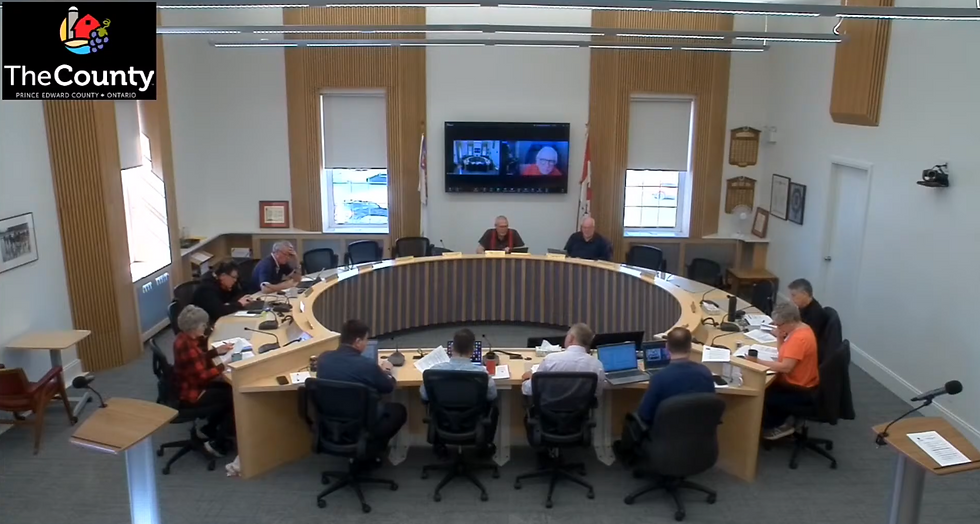
View the entire PEC Council meeting, or continue to speaker comments and councillor votes.
A financial snapshot raised as many questions as answers
The first major item was a financial report from staff that laid out the corporation’s current position. Arryn McNichol, the Director of Finance and Information Technology, told the board the corporation is still in what would be expected as a development-stage financial position. It currently has about $550,000 in cash and roughly $690,000 owing to the County, which is its biggest liability. That sparked a long discussion.

Board members wanted clarity on several items, including a $36,000 CMHC loan payable, the amount listed under tangible capital assets work in progress, and the growing amount shown as accrued liabilities due to the County. Arryn explained that the work-in-progress figure reflects what has been spent so far on capital projects and would remain there until a project is substantially complete.
But the more important debate was about how the money owed to the County should be treated. Board member Hilary Spriggs questioned whether that amount should really be shown as debt at this stage, especially since there appears to be no clearly defined repayment structure in place. She argued that, without a formal agreement, it may look more like a contribution than a true debt, and that distinction matters if the corporation is trying to secure outside financing.
That concern kept coming up from several angles. Board members pointed out that lenders reviewing the books could see a large liability and view the corporation as financially weak, even though much of that money reflects years of development work needed to get affordable housing off the ground.
There was also discussion about the Nile Street property, where unexpected environmental issues appear to have added major costs. Penny Morris raised the point that some of those costs may be more appropriately absorbed by the County, especially since the property had those issues before the affordable housing corporation tried to move it forward. Staff said that if the board wants to ask Council for some kind of relief or reimbursement, staff can bring that request forward, but the board would first need more background information.
That led to one of the clearest themes of the meeting: there is still a lot of history tied to these properties that current board members were not around for, and they want the full record before making big decisions.
To help sort that out, the board directed staff to complete a reconciliation of CMHC funding related to the Nile Street Wellington and Disraeli Street Picton projects and report back with the results and recommendations. Hilary also successfully amended the motion so staff must review the service level agreement for details related to debts and repayment.

That matters because the board spent a lot of time questioning whether future revenue from a completed housing project could realistically cover both debt repayment and operating costs. Several members stressed that affordable housing is not a profit-making venture. In fact, the whole purpose is to keep rents low, which can leave very little room for repaying historical costs. That raised broader questions about whether the County may eventually need to budget annual support, rather than expect the corporation to pay everything back in the way a private developer might. Another point of confusion involved older bookkeeping entries, including a deposit related to a Nicholas Street property. Staff said they are digging through older records to find backup for several items that do not currently have enough detail attached to them.
Because of the amount of follow-up required, St-Jean suggested a special meeting may be needed before the next regular meeting so the board does not lose another 30 days waiting to continue the discussion.
Disraeli stayed in focus as financing talks continued
The second major portion of the meeting shifted to project updates, especially the Disraeli Street Apartments proposal. Staff reported that the board is still pushing ahead with funding applications and financing options, even though the path has become more complicated.
The board supported moving ahead with a Build Canada Homes application seeking $1.7 million in grant funding for Disraeli. Hilary explained that if successful, that funding could allow all eight units in the project to be affordable, instead of only a portion of them.
At the same time, the board also discussed the latest version of the project’s pro forma and the reality that financing through First National Financial and CMHC MLI Select may require more equity up front than expected. Hilary explained that the corporation had hoped for a larger loan, but after recent discussions with First National, it appears the corporation’s financial strength is being viewed cautiously. That means the board may need to raise cash equity or find another way to close the gap.
Even with that setback, the board did not stop. It approved a motion to receive the in-progress pro forma, extended the contract negotiation period with Theberge Homes to April 30, 2026, and agreed to continue pursuing financing for the Disraeli project through First National.
There was also a smaller but important update on the action tracker. Staff confirmed that the topographical survey for Disraeli has been completed and sent to Theberge, which helps move site and servicing work ahead.
Key Takeaways
The affordable housing board is still actively trying to move both Disraeli Street and Nile Street Wellington forward, but financial structure and past costs are still major hurdles.
The board is now openly questioning how past County spending, environmental remediation costs, and old accounting entries should be treated, and those answers could affect future financing.
The Disraeli project is still alive, but timing matters. The board extended negotiations, kept funding applications moving, and signalled that the next few weeks will be important if it wants to keep momentum going.
Disclaimer: This article is based on a meeting with an approximate duration of 1:18:37. Due to the length of the meeting, our team was not able to independently review the full recording in its entirety. As a result, we relied on software-generated transcription, automated summarization, and automated recognition of speakers and participants, which may not be entirely accurate. All transcriptions, summaries, and related content are prepared by our team in good faith and on a reasonable best-efforts basis. The content is provided for general informational purposes only and is intended to support public understanding of the topics discussed. While reasonable efforts have been made to present the information accurately, automated processes may result in errors, omissions, or unintended misinterpretations. This article does not constitute an official, certified, or verbatim record of the meeting, and it should not be relied upon as such. Readers are encouraged to consult original source materials, official minutes, or recordings where available for confirmation or clarification. Questions, requests for clarification, or suggested corrections may be submitted to hello@pecconnect.ca for review and consideration.


Comments