
Part 2: Key Voices Reveal the Reality Behind Rural Housing Challenges - 05/22/2025
- PECConnect
- May 22, 2025
- 4 min read
The second half of the meeting was driven by specific voices who brought clarity to the real challenges behind affordable housing in Prince Edward County. Rather than abstract policy discussion, this portion focused on lived experience, stalled projects, and the gap between federal frameworks and rural reality.
Albert Paschkowiak on the Hidden Housing Crisis
Albert Paschkowiak, Environmental Services and Sustainability Supervisor, delivered one of the most grounded and revealing explanations of how housing actually functions in the County. He described what he called a hidden rental market, made up of basement units, shared homes, and informal living arrangements that are never captured in official statistics.
He explained that many residents rely on these arrangements because there are simply not enough formal rental units available. As a result, the data used by federal programs paints an incomplete and misleading picture of affordability.
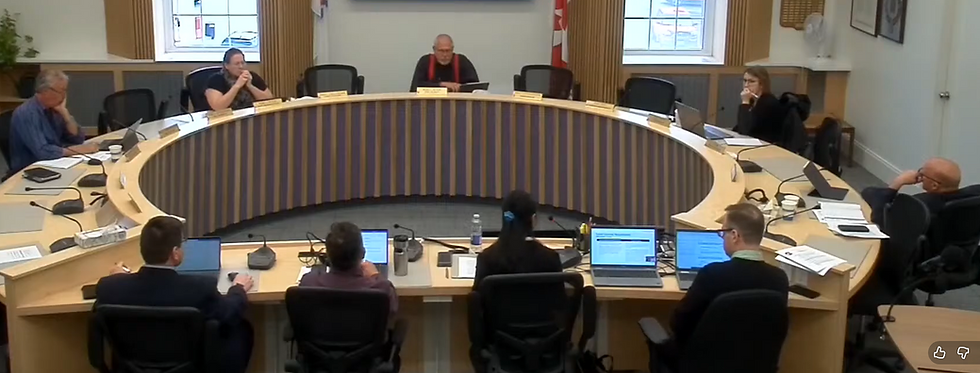
View the entire PEC Council Meeting; or view our recap.
Paschkowiak emphasized that people are either paying an unsustainable portion of their income on rent or are being forced to leave the County altogether. His message was clear and direct: the need is severe, even if the numbers do not show it. His comments helped anchor the entire discussion in reality, showing that the crisis is already happening, even if it is not fully visible in datasets.
Adam on Why Projects Stall Before They Start
Adam, Acting CAO and Director of Housing, provided a detailed breakdown of why affordable housing projects struggle to move forward, even when they appear ready.
He pointed to a 12 unit affordable housing project that already has land secured, community support, and clear demand. Despite this, the project remains stalled because the corporation cannot afford the hundreds of thousands of dollars in upfront costs required for design work, feasibility studies, and cost estimates needed just to apply for CMHC funding.
Adam stressed that there is no guarantee of approval after these investments, making the risk too high for a small rural housing corporation. He also highlighted the requirement for municipalities to contribute 25 percent upfront funding, calling it unrealistic for a community with limited financial capacity.
His remarks made it clear that the barrier is not a lack of ideas or willingness, but a system that requires significant capital before support is even considered. He grounded his comments in real, active projects that are currently stuck, making the issue tangible rather than theoretical.
Annie Lee on Flexibility Within CMHC Programs
Annie Lee, representing CMHC, responded directly to concerns raised throughout the meeting and acknowledged many of the limitations being discussed.

She confirmed that data gaps exist, especially in rural areas, and stated that CMHC is open to project by project discussions rather than relying only on national datasets. She explained that municipalities can submit alternative evidence, including local market studies, internal data, and feasibility reports, to strengthen their applications.
Lee also clarified several technical points that could significantly impact local projects. One key clarification was that Prince Edward County developments may use Belleville as a comparator, which can add nine points under the Apartment Construction Loan Program, improving access to better financing terms.
She further confirmed that CMHC can accept municipal definitions of affordability, as long as they are formally documented. This opened the door for the County to better align funding applications with local realities instead of relying strictly on federal formulas.
Her responses showed that while the system is structured, there is some room for flexibility, though it requires careful navigation and strong supporting documentation.
Steve Ferguson on Housing and the Local Economy
Steve Ferguson, Mayor of Prince Edward County, brought the discussion to a broader level by connecting housing directly to the local economy.
He explained that when residents cannot afford to live in the County, they are forced to move further away. While some may initially commute, over time many stop working locally altogether, which weakens the local workforce and economic stability.

Ferguson emphasized that housing is the top priority for the County, and that the creation of the Affordable Housing Corporation was a deliberate step to take responsibility at the local level. However, he made it clear that local effort alone cannot overcome the structural barriers built into funding systems.
His message reinforced that the issue is not a lack of action, but a lack of accessible funding mechanisms that work for rural communities.
What This Meeting Revealed Through These Voices
Through the perspectives of Albert Paschkowiak, Adam, Annie Lee, and Steve Ferguson, a consistent picture emerged. The County is facing a real and urgent housing crisis, but the systems designed to address it do not align with rural conditions.
The discussion showed that housing challenges are shaped by invisible rental markets, high upfront financial barriers, rigid program requirements, and data that does not reflect reality. At the same time, it revealed that there are small but meaningful areas where flexibility exists, particularly when local data and clear documentation are used.
While no immediate solutions were approved, the meeting moved the conversation forward by clearly identifying where the problems lie and who is responsible for addressing them.
Disclaimer: This article is based on a meeting with an approximate duration of 2:49:40. Due to the length of the meeting, our team was not able to independently review the full recording in its entirety. As a result, we relied on software-generated transcription, automated summarization, and automated recognition of speakers and participants, which may not be entirely accurate. All transcriptions, summaries, and related content are prepared by our team in good faith and on a reasonable best-efforts basis. The content is provided for general informational purposes only and is intended to support public understanding of the topics discussed. While reasonable efforts have been made to present the information accurately, automated processes may result in errors, omissions, or unintended misinterpretations. This article does not constitute an official, certified, or verbatim record of the meeting, and it should not be relied upon as such. Readers are encouraged to consult original source materials, official minutes, or recordings where available for confirmation or clarification. Questions, requests for clarification, or suggested corrections may be submitted to hello@pecconnect.ca for review and consideration.


Comments