
Part 2: Farmland Protection Took Priority as the Committee Drew Clear Lines on Growth - 10/27/2025
- PECConnect
- Oct 27, 2025
- 4 min read
Updated: Jun 18
The committee began by formally confirming the agenda and adopting the April 7, 2025 minutes, with no conflicts of interest declared. While these were routine votes, they set the tone for a focused meeting, allowing members to move quickly into more substantial discussions around farmland protection and increasing planning pressures across the County.
Farmland protection and the whole County
During the deputation from Jenna Salvatore of the Ontario Farmland Trust, committee members largely listened before responding with clear support. One member shared a personal experience working with farmland protection tools, noting that the process had been smooth, while another asked for clarification on how many parcels are currently protected in the County. Salvatore confirmed that seven parcels are already under protection, reinforcing the idea that this approach is already taking hold locally. The committee later voted to receive the deputation, meaning the information is now part of the official record and can be referenced in future decisions around development and farmland conversion.
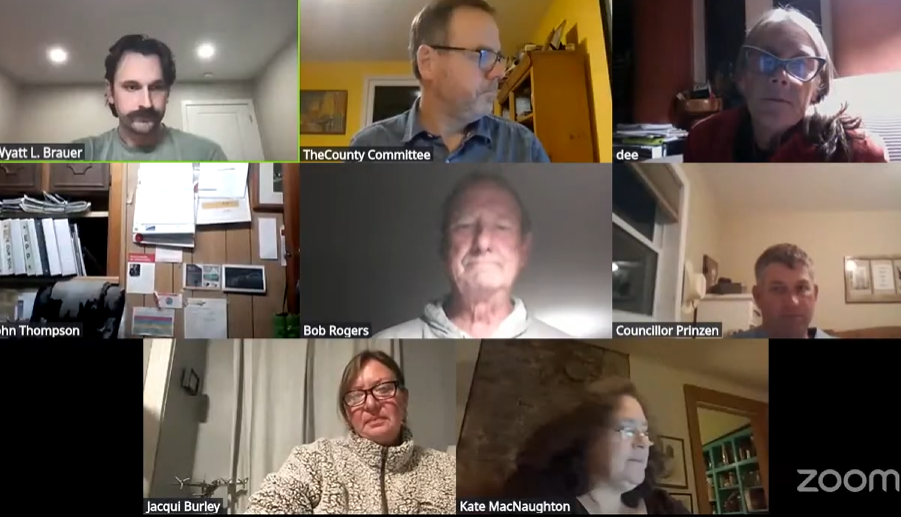
View the entire PEC Council Meeting; or view our recap >
Bill 21 Protect Our Food Act, 2025 and how the vote landed
This section was led on screen by Councillor Kate MacNaughton with draft resolution language. Paulina Szlachta, Chair of the Environmental Advisory Committee, jumped in as a non member to support the Agriculture Committee taking the lead and suggested including the local farmland loss figure discussed earlier to make the resolution hit harder for the County.
Members reacted in agreement, with multiple voices supporting the language and calling the local loss number disturbing. The Chair also added local context about severances and how extreme the County’s numbers are compared to other places. The committee voted yes to approve the resolution supporting Bill 21 and urging the province to protect farmland, with the understanding it goes to County Council first and then onward.
Ameliasburgh and the 3131 Victoria Road file
Planning applications brought a more cautious tone, particularly around how incremental changes can affect agricultural areas over time. For the zoning bylaw amendment at 3131 Victoria Road in Ameliasburgh, members raised concerns about how event-style uses often expand beyond their original scope, leading to increased parking, additional infrastructure, and sometimes accommodations. The Chair pointed to the area’s strong livestock history and the reality that multiple event venues are already operating nearby, creating competition and added pressure. The committee voted to endorse the Planning Working Group submission, signaling support for maintaining stability in agricultural land use and limiting potential conflicts such as traffic, complaints, and pressure on farm operations.
Bloomfield Hollow and the Fair Acres lot line adjustment

This was the most direct farmland loss discussion. Planning staff clarified it was a lot line adjustment with no new lots created, framed as farmland consolidation plus a small parcel containing an existing house. Committee members were not convinced it was harmless, arguing it functions like a severance in practice and chips away at prime farmland.
The Chair raised a specific policy concern about the surplus dwelling and ten year criteria, pointing out the house is relatively new and does not fit the usual rules. The committee voted to receive the discussion, not to approve the application. Receiving the discussion still matters because it places the committee’s objection and reasoning into the record while planning has not yet made a final recommendation. For locals, this is about setting a line against gradual quasi lot line development, especially in prime farmland areas where every small carve out adds up.
Work plan priorities by local need
The meeting also turned toward ongoing priorities through the committee’s work plan, where members focused on practical issues affecting both residents and farm operators. Farm safety was highlighted, including the need for better slow-moving vehicle signage on key routes, alongside continued advocacy work such as tracking planning applications and maintaining a presence in land use discussions. There was also a brief update noting increased use of agricultural mental health supports in the County, pointing to a growing awareness of farmer well-being. The committee voted to receive both the work plan and the 2026 meeting schedule, which places most meetings early in the year due to the election cycle.
What this means for residents
The discussions and decisions from this meeting point to a continued focus on protecting farmland while managing increasing development pressure across the County. The support for the Ontario Farmland Trust deputation and the acknowledgment of existing protected parcels show that long term farmland preservation tools are already being used locally and may become more common over time.
The committee’s support for Bill 21 and the decision to move that resolution forward to Council signals a coordinated effort to advocate for stronger provincial protection of agricultural land. This creates a clearer position from the County when responding to policy changes and reinforces that farmland loss is being treated as an ongoing concern.
At the same time, the cautious approach to planning applications, particularly in areas like Ameliasburgh, reflects an effort to manage how non agricultural uses expand in rural areas. Concerns about incremental changes, such as event venues growing over time, highlight the importance of maintaining compatibility with existing farm operations and limiting potential conflicts.
Overall, the meeting shows that farmland protection, land use stability, and long term agricultural viability remain central considerations in how decisions are being reviewed and recommended to Council.
Disclaimer: This article is based on a meeting with an approximate duration of 1:04:39. Due to the length of the meeting, our team was not able to independently review the full recording in its entirety. As a result, we relied on software-generated transcription, automated summarization, and automated recognition of speakers and participants, which may not be entirely accurate. All transcriptions, summaries, and related content are prepared by our team in good faith and on a reasonable best-efforts basis. The content is provided for general informational purposes only and is intended to support public understanding of the topics discussed. While reasonable efforts have been made to present the information accurately, automated processes may result in errors, omissions, or unintended misinterpretations. This article does not constitute an official, certified, or verbatim record of the meeting, and it should not be relied upon as such. Readers are encouraged to consult original source materials, official minutes, or recordings where available for confirmation or clarification. Questions, requests for clarification, or suggested corrections may be submitted to hello@pecconnect.ca for review and consideration.


Comments