
Part 1: Air Show Sponsorship and Big Policy Updates on Fleet, Fire, and Fees - 10/12/2023
- PECConnect
- Oct 12, 2023
- 7 min read
The County council’s Committee of the Whole met at Shire Hall in Picton on October 12, 2023, to hear a deputation and work through several staff reports that set up decisions heading into the October 24 Council meeting and the 2024 budget process.
The meeting was chaired by Councillor Chris Braney, with Mayor Steve Ferguson and councillors from across the county in attendance. From the outset, the Chair reminded everyone that motions at Committee of the Whole are not final until the October 24 Council meeting, where Council can approve, amend, or change what was advanced at committee.

View the entire PEC Council Meeting, or continue to speaker comments and councillor votes>
A deputation brings the Quinte International Air Show to the table
The first major moment of the afternoon was a deputation about the Quinte International Air Show. Jacqueline St-Pierre, Manager of Business Development at 8 Wing CFB Trenton, presented on behalf of Mr. Trump, who was not available. St-Pierre explained the show was planned as a two day military air show and described a goal of attracting more than 100,000 attendees.
St-Pierre walked Council through several operational changes intended to reduce congestion, based on challenges experienced in prior years. Ticket checks were described as moving into parking lots before attendees board shuttles, with the aim of making entry at the base gates faster. The presentation also described staggered entry times for different groups and an expanded approach to shuttle locations.
A recurring theme in the deputation was how municipalities could plug into communications planning. St-Pierre described the value of real time traffic and travel messaging coming from the site, and an interest in having municipal communications staff involved, both in planning and on the days of the show.
Council members asked about sponsorship options and whether there were packages for individuals, including questions about whether a family option might exist. St-Pierre explained an individual VIP sponsorship package was available, and also spoke about a range of sponsorship levels, including a local business tier.
The sponsorship request that emerged from discussion was specific. Committee carried a direction that the request for $25,000 in corporate sponsorship be explored with Visit The County and brought back through the 2024 budget deliberations.
H.J. McFarland redevelopment: moving ahead, but tied to provincial funding
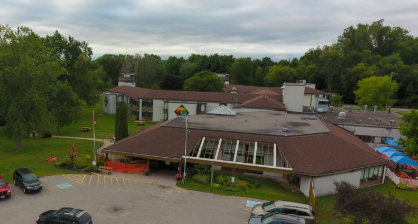
The next major item was a Long Term Care redevelopment update for H.J. McFarland Memorial Home. Kyle Cotton, Director of Long Term Care, was present for the report, and discussion focused on keeping project momentum while recognizing the project’s funding reality.
A key tension ran through the conversation. Council heard that staff wanted to advance the project to the schematic design phase so the County could stay “shovel ready,” but staff also emphasized the project could not proceed without additional provincial accelerated construction funding.
Council members used this agenda item to put design priorities on the record, including sustainability and “green” design considerations. Councillors spoke about landscaping expectations tied to the County’s tree policy, building orientation and shade, tree canopy in parking areas, and interest in a more decarbonized HVAC approach to reduce long term operating costs.
Another thread was the relationship between a home like environment and the building’s scale and density, including follow up discussion about Family Council feedback and the importance of clear responsiveness.
Staff also clarified the often misunderstood “square feet per resident” figure and discussed room types and costs, including how the design’s 60 percent private and 40 percent basic accommodation approach compared with current operations and broader sector norms. There was also discussion about whether demand could shift and what flexibility exists within the design, alongside clarification that licensing is based on the number of beds.
Funding questions stayed front and centre. Council asked what was known about provincial support, how close the County could get to shovel ready, and what would happen with fire code requirements at the existing facility if redevelopment timelines stretched. Staff and the Fire Chief spoke about compliance pathways and alternative measures that could be used while working toward replacement, with an emphasis on meeting requirements by the relevant deadline.
Committee ultimately carried a motion to receive the report, direct staff to move into schematic design, and create a capital project in the 2024 budget, pending additional accelerated construction funding from the province.
Fleet management: a policy update built on data, risk, and long range planning
Council then shifted into a detailed Operational Services report on fleet asset management, including a draft updated policy and a longer term forecast. Adam Goheen, Director of Operational Services, presented a structured case for treating the fleet as a managed set of assets, tying vehicles and equipment directly to the County’s ability to deliver legislated and council directed services.
The presentation emphasized building a sustainable life cycle plan through better data, clearer replacement criteria, and explicit risk thinking. Examples were used to show how the consequence of a breakdown can be minor in some cases but critical in others, especially during storm events and winter operations.
Staff provided a snapshot of the fleet’s composition and age profile, suggesting the distribution was generally healthy and reflective of ongoing investment. They also described how seasonal needs are being handled in part through rentals to reduce the need for purchases that would sit idle.
Modernization came up as well. Staff described movement toward hybrid vehicles in parts of the fleet and said full electric was not an immediate plan, while plug in hybrid options were under review as the market evolves.
The report also addressed internal chargeout rates, describing them as a mechanism to recover fleet costs across departments. Staff noted rates would likely need to rise, with a phased approach anticipated, especially given inflation pressures and the goal of building a more self sustaining replacement funding model.
Council questions ranged from the durability of a proposed rotary broom attachment, to replacement mileage guidelines, record keeping and daily logs, and suggestions about procurement considerations. Committee carried the motion to receive the report, direct staff to develop new internal chargeout rates for consideration at the 2025 budget discussions, rescind the prior policy, and approve the draft fleet management policy.
Fire services: community risk assessment and a bylaw update on non emergency service levels
The Fire Department’s Community Risk Assessment report came forward next. Fire Chief Chad Brown was present, and the discussion was notably brief and appreciative in tone.

Councillors and the Mayor thanked fire staff for their public education and community presence, referencing activities that many residents would recognize from local events. Committee carried the motion to receive the report and approve bringing forward a bylaw amendment to establish non emergency levels of service by the fire department at the October 24 Council meeting.
Fees and charges: a new approach to municipal space use, plus tourism pressure points
The final major report was the 2024 Fees and Charges By Law. Discussion moved quickly into practical, real world examples, because many councillors had been hearing from community groups about how hard it can be to navigate facility bookings and fees.
A central idea in the conversation was making it easier for the public to use municipal buildings for broadly accessible community events. Staff described an approach that would allow certain events to use spaces without fees when the event is public, promoted beyond a closed circle, and not run as a commercial ticketed event. Council discussed how “by donation” models can sometimes raise more support than a fixed price while keeping events accessible.
Councillors also raised edge cases, like membership based groups and events with limited capacity, and staff spoke about designing criteria that are easy to apply without turning the decision into a subjective staff judgment about what counts as “community good.” Staff noted that wording adjustments were expected before the bylaw returned to Council, including clarity around the requirement that events be publicly advertised.
The conversation widened to include concerns heard in the community about Wellington Beach admission fees and broader tourism management measures. Staff indicated a more comprehensive review of tourism management was expected to return in a future report, rather than treating that issue as a single line item in the fees bylaw discussion.
Council also asked about the fingerboard sign annual maintenance fee, and staff explained it as a way to fund upkeep, replacements for damaged or stolen signs, and maintenance of the broader sign infrastructure.
Committee carried the motion to receive the report and approve the 2024 Fees and Charges By Law at the October 24 Council meeting.
Key Takeaways
The County’s approach to big projects is being shaped around readiness and realism. On H.J. McFarland, Council supported moving into schematic design to keep momentum, while staff repeatedly tied the project to provincial accelerated funding as the deciding factor.
Several policy decisions advanced that will show up in how services run day to day. Fleet planning was framed as risk management and long term lifecycle planning, fire services brought forward work on non emergency levels of service, and fees and charges discussions focused on simplifying how residents and groups access municipal spaces.
Community impact questions kept surfacing in practical ways. From traffic and communication planning for a major regional air show, to how long term care design choices support residents and families, to whether fees and tourism management tools are still working as intended, the discussion repeatedly circled back to how policies land on people across the county.
Disclaimer: This article is based on a meeting with an approximate duration of 1:56:31. Due to the length of the meeting, our team was not able to independently review the full recording in its entirety. As a result, we relied on software-generated transcription, automated summarization, and automated recognition of speakers and participants, which may not be entirely accurate. All transcriptions, summaries, and related content are prepared by our team in good faith and on a reasonable best-efforts basis. The content is provided for general informational purposes only and is intended to support public understanding of the topics discussed. While reasonable efforts have been made to present the information accurately, automated processes may result in errors, omissions, or unintended misinterpretations. This article does not constitute an official, certified, or verbatim record of the meeting, and it should not be relied upon as such. Readers are encouraged to consult original source materials, official minutes, or recordings where available for confirmation or clarification. Questions, requests for clarification, or suggested corrections may be submitted to hello@pecconnect.ca for review and consideration.


Comments