
Part 2: Wellington Infrastructure Referral, Uride Votes, and Planning Decisions – 11/28/2023
- PECConnect
- Nov 28, 2023
- 5 min read
This second part of the November 28, 2023 Council meeting recap focuses on who said what, how councillors voted, and how those decisions and debates affect residents across Prince Edward County. It follows the same meeting sequence and draws strictly from the transcript and official minutes.
The tone of the meeting was strongly shaped by deputations and public speakers before Council reached any formal votes on infrastructure.
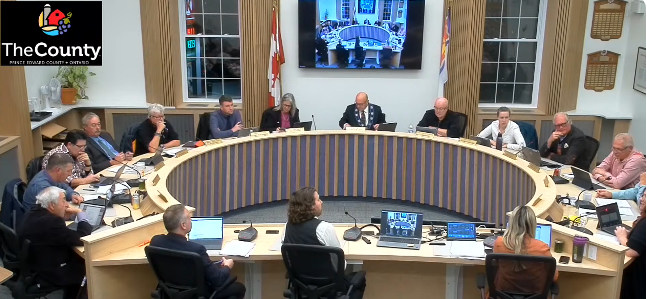
View the entire PEC Council Meeting; or view our recap.
Paul DeMelo, Legal Counsel for Base31, presented early and spoke at length about water and wastewater infrastructure as a long-term growth obligation. DeMelo emphasized that servicing decisions are tied to commitments already made by the County through planning approvals, and that infrastructure supports not only housing but employment lands, hospitals, and long-term care facilities. His comments positioned the Wellington works as part of a broader Master Servicing Plan, rather than a standalone project.
Mike Harper, speaking as a resident, reinforced the urgency of addressing aging infrastructure. Harper spoke about risks of system failure, replacement timelines, and the importance of maintaining trust in legally binding agreements, while also pressing Council to reassure ratepayers that water rates would remain stable.
During Comments from the Audience, the strongest and most consistent opposition came from Wellington residents and community representatives.
Helen Prolas, Kevin Hanbury, Andy Bowers, Carol Mannheim, Tim Good , Rick Conroy, Jennifer Armstrong, Ron Waslenko, Diane Scott, and Ernie Margetson all spoke to Item 11.2, the Wellington trunk water and sewer tender. While their perspectives varied, most urged Council to pause the project, citing financial risk, uncertainty about developer follow-through, affordability pressures, and concern about community character.
Jennifer Armstrong spoke directly about housing affordability and the lack of guaranteed affordable units, saying that younger residents risk being priced out if infrastructure debt increases without firm commitments from developers.
Ernie Margetson offered a more procedural critique. He acknowledged the trunk lines would eventually be required, but urged Council to tie any infrastructure approval directly to a signed subdivision agreement, ensuring the developer’s financial contributions are secured at the same time the County commits capital.
How Council divided on Uride and transportation
The most complex voting sequence of the night occurred under Item 11.1, the report on Uride and community transportation solutions.
Julianne Snepsts, Programs Supervisor, explained that Uride currently provides a significant share of on-demand transportation in the County and that the proposed $30,000 wage subsidy would be funded through Municipal Accommodation Tax revenues, not general taxation.

Councillors split sharply.
Phil St.-Jean (Picton) spoke repeatedly against the subsidy, arguing that Uride has received financial support while existing taxi companies have not. St-Jean raised concerns about fairness, regulatory exemptions under the Taxi By-Law, and the loss of a local taxi operator during the same period Uride was subsidized.
Roy Pennell (Ameliasburgh) also opposed subsidizing private businesses and requested recorded votes, stating municipalities should not be funding wages.
On the other side, Kate MacNaughton (Picton), John Hirsch (South Marysburgh), Janice Maynard (Ameliasburgh), and others highlighted gaps in rural and late-night transportation, impaired driving concerns, and the practical limitations of the current transit system.
Council voted on three motions in sequence.
A motion to remove the Uride subsidy entirely was defeated, with Pennell, Brad Nieman (Bloomfield-Hallowell), Corey Engelsdorfer (Wellington), Sam Grosso (Ameliasburgh), David Harrison (Wellington), and others in favour, and a majority opposed.
A second motion to reduce the subsidy to $15,000 and redirect the remainder to micro-grants was also defeated.
When Council voted on the full report, including the $30,000 subsidy, Taxi By-Law review, and micro-granting program, that motion was likewise defeated, leaving the Uride agreement unapproved.
The Wellington trunk infrastructure decision and referral
Under Item 11.2, Council faced the formal decision on whether to award the Wellington Watermain Trunk and Sanitary Sewer Trunk Linear Infrastructure tender.
Rather than voting directly on construction and borrowing, Corey Engelsdorfer moved to refer the report to the municipal solicitor. The intent was to clarify financial guarantees, developer obligations, and legal exposure before proceeding. The referral motion passed unanimously, with all councillors voting in favour.

As a result, the motion to approve additional long-term debt, execute the construction agreement with Clearway Construction Inc., and move the project forward was formally deferred.
This was a pivotal procedural moment. Council did not reject the project, but it chose not to proceed without stronger legal certainty.
Other votes that moved forward
Council approved the Picton Main Street sanitary pump station tender, with Kate MacNaughton and Phil St-Jean moving the motion. Staff confirmed the facility is at the end of its service life and must proceed to avoid operational and safety risks.
Council also supported a resolution, again brought forward by Corey Engelsdorfer, to direct staff to prepare a background report on development charge pre-payment agreements and to undertake a third-party review of the 2021 Water Financial Plan. One clause was removed to narrow scope, but the amended motion carried.
In planning matters, John Hirsch successfully moved to refer the Trey Resort rezoning on County Road 7 back to staff. Hirsch cited public feedback and potential design changes that could reduce neighbourhood impacts. Council supported the referral.
What this means for residents
For Wellington residents, the key outcome is that the trunk water and sewer project is paused, not cancelled. Council is seeking legal clarity before committing debt, which responds directly to local concerns about affordability, risk, and developer accountability.
For Picton, infrastructure investment continues, with the Main Street sanitary pump station moving ahead to address immediate system needs, independent of the Wellington decision.
For rural wards, the failed Uride motions mean no immediate funding decision was made on on-demand transportation, leaving existing service gaps unresolved for now.
The meeting signals that Council is increasingly cautious about growth-related infrastructure, particularly where long-term debt, development charges, and affordability intersect. Residents across Prince Edward County can expect these same issues to return quickly to the agenda, with higher scrutiny and clearer demands for financial certainty.
Disclaimer: This article is based on a meeting with an approximate duration of 5:01:32. Due to the length of the meeting, our team was not able to independently review the full recording in its entirety. As a result, we relied on software-generated transcription, automated summarization, and automated recognition of speakers and participants, which may not be entirely accurate. All transcriptions, summaries, and related content are prepared by our team in good faith and on a reasonable best-efforts basis. The content is provided for general informational purposes only and is intended to support public understanding of the topics discussed. While reasonable efforts have been made to present the information accurately, automated processes may result in errors, omissions, or unintended misinterpretations. This article does not constitute an official, certified, or verbatim record of the meeting, and it should not be relied upon as such. Readers are encouraged to consult original source materials, official minutes, or recordings where available for confirmation or clarification. Questions, requests for clarification, or suggested corrections may be submitted to hello@pecconnect.ca for review and consideration.


Comments