
Part 1: Infrastructure pressure, transportation discussion, and a long night – 11/28/2023
- PECConnect
- Nov 28, 2023
- 5 min read
Updated: May 25
The County Council met on November 28, 2023, at Shire Hall in Picton for a regular council meeting that stretched late into the night and covered a wide range of consequential issues for the municipality. The meeting was chaired by Mayor Steve Ferguson, with all councillors present, and was held to advance decisions on infrastructure, transportation, planning, and governance matters that continue to shape growth and service delivery across the County.
From the outset, it was clear this would not be a routine evening. After returning from a closed session dealing with surplus municipal land sales, Council moved into a series of presentations and deputations that set the tone for the rest of the meeting. Much of the discussion centred on water and wastewater infrastructure, particularly in Wellington, and the financial risks and growth assumptions tied to those investments.
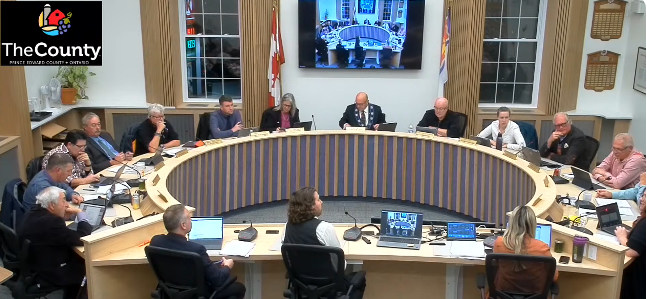
View the entire PEC Council meeting, or continue to speaker comments and councillor votes>
Following procedural approvals and announcements, Council formally recognized community initiatives and partnerships. A presentation highlighted financial support from the Prince Edward District Women’s Institute for accessible transit, reinforcing ongoing concerns about mobility and inclusivity across the County.
Council then heard from Chris Palmer, Supervisor of Museums and Cultural Services, who presented on The Arrow Trail Project. The discussion focused on regional collaboration with Belleville and Quinte West, and how the trail would connect cultural stories and tourism assets across the Bay of Quinte. Council supported advancing the project toward a planned Spring or Summer 2024 launch, signaling continued emphasis on cultural infrastructure and inter-municipal partnerships.
Water and Wastewater Infrastructure Takes Centre Stage
The meeting’s most substantial early discussions came during deputations on water and wastewater infrastructure, beginning with Paul DeMelo, Legal Counsel for Base31. DeMelo spoke to long-term growth commitments already made by the County, the interconnected nature of servicing between Wellington and Picton, and the need for Council to show consistency when planning infrastructure that supports businesses, institutions, and housing.
Questions from Council explored growth forecasts, aging systems, and how development agreements intersect with affordability and community expectations.
A second deputation from Mike Harper reinforced concerns about system reliability, replacement timelines, and the risks of delaying upgrades. Harper emphasized the fragility of existing infrastructure and the importance of trust in legally binding agreements, particularly when costs continue to rise.
Together, these deputations framed infrastructure not as a single project decision, but as part of a longer arc of planning, investment, and risk management that Council would revisit repeatedly throughout the evening.
Extended Public Comments on Wellington Infrastructure
Public concern intensified during Comments from the Audience, which Council formally extended beyond the usual time limit due to the volume of speakers. Residents, community association representatives, and ratepayers spoke almost exclusively about the proposed Wellington Watermain Trunk and Sanitary Sewer Trunk Linear Infrastructure.
Speakers raised recurring themes: financial risk, uncertainty around developer commitments, affordability for younger residents and seniors, and skepticism about growth assumptions. Several urged Council to press pause on awarding the tender, citing fears of debt exposure if planned developments do not proceed as expected. Others questioned whether Wellington residents were being asked to shoulder disproportionate costs for infrastructure that supports future growth rather than current needs.
Former councillor Ernie Margetson added a structural lens to the discussion, arguing that while the infrastructure would ultimately be needed, Council should better align its financial commitments with legally binding subdivision agreements. His comments introduced the idea that the issue was not whether to build, but when and under what conditions, a distinction that would later influence Council’s procedural decisions.
Uride and Community Transportation Solutions

After a short recess, Council turned to a report from Community Services, Programs and Initiatives on Uride and community transportation solutions. Presented by Julianne Snepsts, Programs Supervisor, the report examined whether to extend the County’s agreement with the ride-hailing service Uride and how that relationship fits alongside traditional taxi services and public transit.
Council questioned how the subsidy is funded, how Uride operates differently under the Taxi By-Law, and whether continued support creates an uneven playing field for existing operators. At the same time, councillors acknowledged gaps in late-night and rural transportation that Uride currently helps fill.
Multiple motions were introduced to remove or reduce the proposed $30,000 wage subsidy, redirect funds to micro-grants, or restructure the agreement. Each amendment failed. When Council voted on the full recommendation package, the motion was also defeated, leaving no approval in place for extending the Uride agreement and highlighting deep divisions over how transportation services should be supported.
Wellington Trunk Infrastructure Formally Deferred
Council then returned to the issue that dominated the evening: the Wellington trunk water and sewer project. Rather than proceeding directly to awarding the tender, Council chose a procedural pause. A motion was passed to refer the report to the municipal solicitor for further advice, with the explicit goal of clarifying financial guarantees, development charge commitments, and the County’s exposure if growth does not materialize as planned.
As a result, the motion to approve additional debt funding and execute construction agreements was deferred, ensuring no final decision was made that night. This referral acknowledged the weight of public concern and the need for clearer legal and financial certainty before proceeding.
Other Infrastructure, Planning, and Governance Decisions
While Wellington infrastructure dominated attention, Council continued through several additional items. Council approved the Picton Main Street sanitary pump station tender, emphasizing the end-of-life condition of the existing facility and the need to avoid delays.
Council also supported a resolution directing staff to prepare a background report on development charge pre-payment agreements and to engage in a third-party review of the 2021 Water Financial Plan, with one clause removed by friendly amendment to narrow the scope.

Later in the meeting, Council addressed committee appointments, consent items, and planning matters. A rezoning application on County Road 7 in North Marysburgh, often referred to as the Trae Resort proposal, was referred back to staff to better reflect public input and reduce neighbourhood impacts. The meeting concluded with routine by-law approvals and adjournment just before midnight.
What Residents Should Take Away From This Meeting
Wellington water and wastewater infrastructure is not approved yet, and Council deliberately paused the process to seek legal advice and stronger assurances before committing to major debt and construction.
Community transportation remains unresolved, with Council unable to reach consensus on how to support Uride while balancing fairness to existing taxi operators.
The meeting underscored a broader tension facing the County: how to plan for growth responsibly while protecting current residents from financial risk, a question that will return to Council in future meetings as these deferred items come back for decision.
Disclaimer: This article is based on a meeting with an approximate duration of 5:01:32. Due to the length of the meeting, our team was not able to independently review the full recording in its entirety. As a result, we relied on software-generated transcription, automated summarization, and automated recognition of speakers and participants, which may not be entirely accurate. All transcriptions, summaries, and related content are prepared by our team in good faith and on a reasonable best-efforts basis. The content is provided for general informational purposes only and is intended to support public understanding of the topics discussed. While reasonable efforts have been made to present the information accurately, automated processes may result in errors, omissions, or unintended misinterpretations. This article does not constitute an official, certified, or verbatim record of the meeting, and it should not be relied upon as such. Readers are encouraged to consult original source materials, official minutes, or recordings where available for confirmation or clarification. Questions, requests for clarification, or suggested corrections may be submitted to hello@pecconnect.ca for review and consideration.


Comments