
Part 1: Redtail Winery Proposal, Rural Severances, and Base31 Zoning Extension - 04/16/2025
- PECConnect
- Apr 16, 2025
- 5 min read
The Planning and Development Committee met on the evening of April 16, 2025, at Council Chambers in Shire Hall, with a full room and virtual attendees following along online. The meeting was chaired by Councillor Kate MacNaughton, Picton Ward councillor, who opened the session by outlining the structure of the evening and the role of the committee under the Planning Act. The meeting was divided into two clear parts: a statutory public meeting focused on new planning applications where no decisions would be made, followed by items for consideration where the committee would be asked to act on staff reports and recommendations.
MacNaughton emphasized that the statutory portion of the meeting was intended to gather information and hear from applicants and the public before staff completed their formal reviews. She also explained how public comments become part of the official record and how participation affects appeal rights under provincial planning legislation. With no disclosures of pecuniary interest and the agenda confirmed, the committee moved into the first major item of the night.
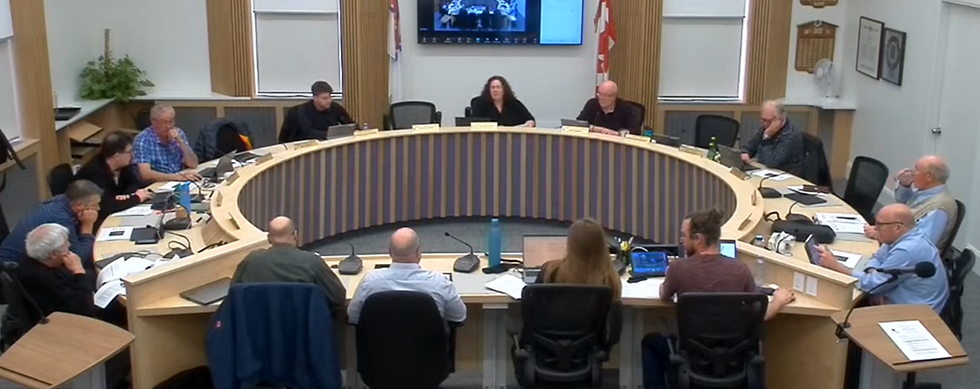
View the entire PEC Council meeting, or continue to speaker comments and councillor votes.
The statutory public meeting centred on a draft plan of condominium and hold removal request related to Redtail Winery, located along Loyalist Parkway in Hillier Ward. The application was presented by Adam Layton, Associate Principal with the Goldberg Group, acting as planning agent for the winery. Layton walked the committee through the long history of the file, which dates back to 2019 and includes previous official plan and zoning bylaw amendments that permitted an estate winery, hotel, and Nordic spa on the property.
Layton explained that the current application was not introducing a new use, but rather advancing the project by lifting holding provisions tied primarily to water supply concerns. He described the extensive hydrogeological work undertaken on the site, including year-long testing that resulted in a permit to take water issued by the province in July 2024. With that permit in place, the development had moved into detailed site plan design, including landscaping, lighting, and building architecture.
Visual materials showed the layout of the proposed development, including the existing winery operations, a central estate winery building, a Nordic spa planned within wooded areas, surface parking, and a series of low-rise hotel villas distributed across the site. Layton stressed that the proposed condominium structure was a legal and ownership tool, not a signal of high-density residential development. The condominium would allow different components of the site, such as the winery, hotel, and spa, to be owned or operated separately while sharing common infrastructure like roads, stormwater systems, and landscaping.
Committee members asked questions about water capacity, wildlife impacts, timing of construction, and how the project would evolve if certain components, such as the spa operator, were not yet finalized. Layton responded by referencing site buffers, woodland protections, and the controls embedded in the site plan agreement process. He also addressed questions about deer movement, noting that fencing was limited and that environmental corridors would remain intact.
Public comments followed, with residents raising concerns about traffic safety, particularly for cyclists along Loyalist Parkway, as well as questions about water use calculations, ecological impacts on wildlife, and night-sky lighting. Layton acknowledged these concerns and committed to follow-up through staff, including consultation with traffic engineers and confirmation that lighting would meet dark-sky standards and be controlled by timers and photocells. MacNaughton repeatedly clarified that this portion of the meeting was informational and that all comments would be reviewed as part of the ongoing planning process.
With no decisions taken, the statutory public meeting for the Redtail Winery application was formally closed, and the committee moved into the second half of the evening: items for consideration.
The committee then turned to a series of consent and rezoning applications, beginning with a straightforward severance in Hallowell Ward where the applicant’s agent, Brendan O’Connor, confirmed agreement with all staff-recommended conditions. That item proceeded quickly, reflecting its limited scope and lack of outstanding issues.
A much longer and more complex discussion followed on consent and rezoning applications in Athol Ward related to the creation of two rural residential lots. This portion of the meeting featured detailed debate over hydrogeological studies, water quality, sodium levels, recovery rates in wells, and the role of provincial guidelines such as D-5-5 and D-5-4. The applicant’s agent challenged one of the recommended conditions requiring further technical studies, arguing that water issues were treatable and that some requirements overlapped with building code responsibilities rather than planning controls.
Staff planner Emily Overholt provided extensive context, clarifying the timeline of the application, the rationale for peer review, and why staff believed additional conditions were necessary to ensure long-term potable water and sustainable servicing in accordance with provincial policy. The discussion highlighted ongoing tensions common in rural planning between technical risk management, buyer awareness, and the limits of municipal authority. While amendments were proposed and debated, the broader focus remained on how to responsibly approve rural development without transferring unreasonable risk to future property owners or the municipality.

The final major item of the night addressed the extension of a temporary use zoning bylaw and interim servicing agreement for Base31, presented by Chris Marchese of PEC Community Partners and Asaf Weiss, President of Base31. They outlined the scale of investment already made at the former Camp Picton site, including major water and wastewater infrastructure upgrades, year-round and seasonal employment, local business partnerships, and public programming that draws tens of thousands of visitors annually.
Staff explained that the extension was tied to delays at the provincial level related to a requested Minister’s Zoning Order, noting that changes in government had slowed the process. The extension was presented as a continuation of the existing framework rather than an expansion of permitted uses. Committee discussion focused on employment impacts, servicing costs, connection charges, and the broader economic role Base31 plays in the County.
The meeting concluded after a long evening of presentations, public input, technical discussion, and formal committee business. While some items moved forward decisively and others revealed deeper policy debates, the session underscored the complexity of balancing growth, infrastructure, environmental stewardship, and transparency in a rapidly evolving
Key Takeaways
Several major development proposals are still in the information stage. The Redtail Winery hotel, spa, and villa project is still early in the planning process. No decisions were made at this meeting, and public comments raised issues around traffic safety, water use, lighting, and environmental impacts that staff will now review before any recommendation comes forward.
Water supply and environmental protection remain central concerns. Questions about groundwater capacity, wildlife movement, and night-sky lighting surfaced repeatedly. These themes signal that future planning decisions in the County will continue to hinge on how well projects demonstrate long-term servicing and environmental safeguards.
Public input at statutory meetings still matters. Residents who spoke were reminded that oral or written submissions at this stage affect appeal rights later. For PEC residents, this meeting reinforced that showing up early in the planning process is one of the few moments when concerns can be formally placed on the record.
Disclaimer: This article is based on a meeting with an approximate duration of 2:04:52 Due to the length of the meeting, our team was not able to independently review the full recording in its entirety. As a result, we relied on software-generated transcription, automated summarization, and automated recognition of speakers and participants, which may not be entirely accurate. All transcriptions, summaries, and related content are prepared by our team in good faith and on a reasonable best-efforts basis. The content is provided for general informational purposes only and is intended to support public understanding of the topics discussed. While reasonable efforts have been made to present the information accurately, automated processes may result in errors, omissions, or unintended misinterpretations. This article does not constitute an official, certified, or verbatim record of the meeting, and it should not be relied upon as such. Readers are encouraged to consult original source materials, official minutes, or recordings where available for confirmation or clarification. Questions, requests for clarification, or suggested corrections may be submitted to hello@pecconnect.ca for review and consideration.


Comments